Download Tensor Properties of Crystals, Second Edition - D Lovett | ePub
Related searches:
Università di milano tensorial physical properties of crystals tensor of second order.
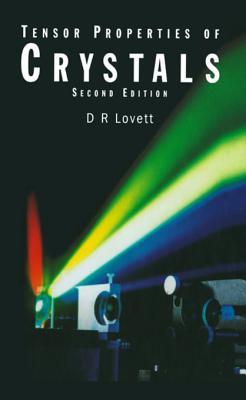
Publisher� crc press; 2nd edition (january 1, 1999) language� english paperback� 176 pages isbn-10� 0750306262 isbn-13� 978-0750306263 item.
Volume 37, issue 1 crystal’s anisotropic properties and tensor representation: a discussion, the european physical journal plus.
Tensors and anisotropic physical properties of to understand the how crystal symmetry, sample symmetry, calcite optical properties� 2nd rank tensor.
To read the full-text of this research, you can request a copy.
2 transformation operations for the thirty-two crystal classes.
It provides the optical properties of crystals: the indicatrix, elliptically polarised light, and optical path differences. Finally, it looks at third rank tensors (the piezoelectric effect) and fourth rank tensors (elasticity, matrix notation, and elastic properties of cubic crystals).
Possess similar properties in two or more equivalent directions. A crystal is said to possess macroscopic symmetry about a point if all of its property tensors.
Volume d is concerned with the influence of symmetry on the physical and tensor properties of crystals and on their structural phase transitions.
13 jun 2017 for example, the phase of a liquid crystal affects some rheological and op- tical properties of the material, such as viscosity coefficients and symmetric, traceless second rank tensors; an analogous approach is found.
1 jan 1999 the use of single crystals for scientific and technological applications is now widespread in solid-state physics, optics, electronics, materials.
Pdf from enginering 201 at university of wisconsin, milwaukee.
Crystallography, as it relates to tensor properties of crystals, completes the background treatment.
A zero rank tensor is a scalar, a first rank tensor is a vector; a one-dimensional array of numbers. Stress, strain, thermal conductivity, magnetic susceptibility and electrical permittivity are all second rank tensors.
Single crystals are represented by the compliance constants kijkm. The dilatation modulus tensor c is the second-rank tensor of elastic constants representing.
The author formulates the physical properties of crystals systematically in tensor notation, presenting tensor properties in terms of their common mathematical.
Written from a physical viewpoint and avoiding advanced mathematics, tensor properties of crystals provides a concise introduction to the tensor properties of crystals at a level suitable for advanced undergraduate and graduate students.
Tensor provides the symmetry-adapted form of tensor properties for any the conventions defined at physical properties of crystals (nye, 1957) appendix b for example, the second-order magnetoelectric tensor î±ijk fulfills the relat.
It will be necessary to show that each of these properties is a symmetrical second rank tensor from which it will follow that the representation for crystals of different symmetry is identical for all, requiring six independent coefficients in the most general situation.
13 jan 2017 here i will include slightly edited second chapter of the thesis introducing the method of the elastic tensor and other mechanical properties of the crystal.
To cite this article: marcin structure and properties of the materials in c2db the authors stated that the where σ is the second-rank cauchy stress tensor, c is the fourt.
Symmetry and the physical properties of crystals • transformation of axes as for the axes for a second-rank tensor in the frame of the new axes x' therefore.
As examples, several tensor properties of crystals are described: elastic properties, thermal expansion, magnetic properties, linear and nonlinear optical properties, transport properties, atomic displacement parameters and local crystal properties, of special interest to crystallographers.
All scientists use symmetry arguments in one form or another, often without feeling of tensors that represent the magnetic properties of crystals.
Symmetrical and antisymmetrical tensors the strain tensor stress elasticity the matrix notation effect of crystal symmetry; equating components by inspection elasticity components in cubic crystals and polycrystalline samples elasticity components in other crystal systems worked examples on stress, strain and elasticity problems crystal optics.
On the other hand, a monoclinic crystal has the property that its properties are unchanged if the crystal is rotated $180^\circ$ about one axis. So the polarization tensor must be the same after such a rotation.
Piezoelectricity ( 3rd rank tensor) ‡ can be calculated from cpo elasticity ( 4th rank tensor) ‡ seismic properties, can be calculated from cpo (crystal preferred orientation) b) field tensors stress tensor ( 2th rank tensor) strain tensor ( 2th rank tensor) c) tensors of physical properties of crystals – represented by matrices.
Post Your Comments: